
Why are professionals switching to this press tool?_Knowledge Center_Latest News | Kinshine Trading Company Ltd.

 Home
Home- Latest News
- Knowledge Center
- Why are professionals switching to this press tool?
Why are professionals switching to this press tool?
A Press Tool Is Not Just About Power: Balance, Automatic Return, and Jobsite Efficiency Matter
Many users ask: aren’t press tools all the same? Why do balance and automatic return matter so much? In real jobsite conditions, the difference is not only whether the tool can press, but how it affects wrist fatigue, working rhythm, and pressing consistency over repeated use.
Three Key Factors Professionals Should Consider When Choosing a Press Tool
The value of a press tool is not determined by output force alone. During long jobsite work, tool balance, automatic return, and system flexibility directly affect efficiency, fatigue, and pressing consistency.
Good weight distribution reduces the perceived weight during operation, lowers wrist fatigue, and helps maintain a stable pressing posture in confined spaces.
After pressing is completed, the piston automatically returns to the starting position. This reduces manual steps and shortens waiting time before the next press.
With compatible press jaws and systems, one tool can support different pipe materials, pipe sizes, and jobsite requirements.
A professional press tool should not only press with enough force. It should help maintain stable, fast, low-fatigue operation and consistent pressing results during repeated work.
1. Avoid Front-Heavy Handling: The Science of Tool Balance
Traditional press tools can sometimes feel front-heavy. During long working hours, this can increase wrist fatigue, especially during overhead work, corner work, or pressing in tight pipe spaces.
A well-balanced tool reduces perceived weight and makes the tool easier to control. For professional users, this is not only a comfort issue. It also affects pressing angle control, stability, and work precision.
If you only press a few joints, the difference may not feel obvious. But on jobsites with repeated pressing work, tool balance directly affects fatigue and efficiency.
2. What Is an Automatic Return System?
After pressing, the piston automatically returns to the starting position, reducing manual operation steps.
Automatic return helps create a more consistent working rhythm and reduces variation between pressing cycles.
During high-volume pressing work, return speed affects the overall jobsite rhythm and continuous working efficiency.
Removing one manual retraction step helps reduce accumulated fatigue during long-duration work.
In high-volume pressing work, rhythm differences become obvious. Automatic return makes the workflow smoother and lets the operator focus more on fitting position and pressing quality.
3. One Tool for More Jobsite Applications
The value of a press tool is not limited to one pipe size or one material. A tool becomes more valuable when it can work with different press jaws and press systems to handle more jobsite conditions.
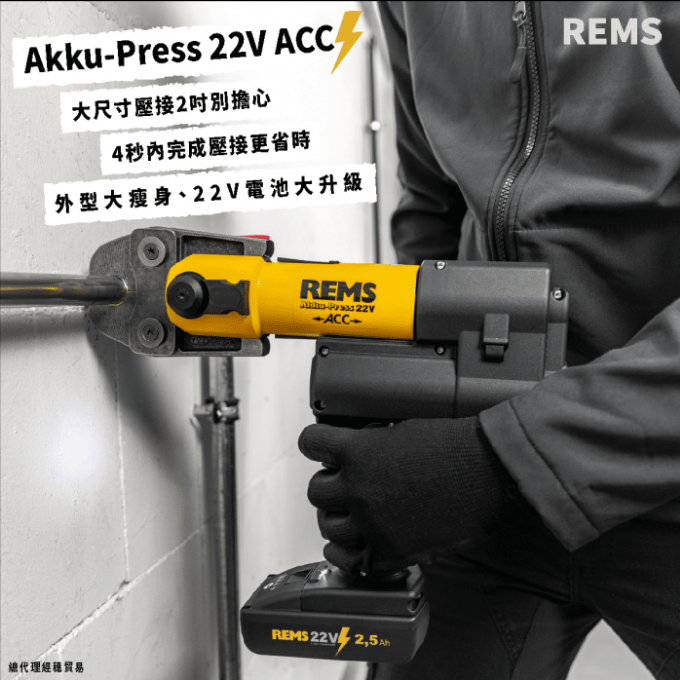
The REMS E22V series can be used with corresponding press jaws according to the press system. The actual pressing range should always be confirmed based on the fitting, jaw, and system specifications.
When a tool can handle different jobsite requirements, it is no longer just a single-purpose tool. It becomes part of a more flexible pressing system.
For professional users, ergonomics, automatic return, and system flexibility directly affect long-hour efficiency and fatigue. A good press tool should make every press more stable and consistent.